How We Verify AI Accuracy at Freedom AI: Why It Matters for Education
Artificial intelligence is transforming classrooms, tutoring, research, and student support systems. But as educators increasingly rely on AI, whether to generate study guides, explain concepts, assess learning, or provide feedback, one question matters more than ever:
Can we trust the accuracy of AI-generated content?
At Freedom AI, our work is rooted in transparency, responsibility, and academic integrity. We believe AI should empower students, not mislead them. That is why our accuracy verification process is designed with learning environments in mind.
Here is how we evaluate AI accuracy and what it means for students, teachers, and the future of education.
1. Establishing Ground Truth for Learning Environments
Academic accuracy requires a clear standard, which educators often call ground truth.
Depending on the subject or learning task, ground truth may include:
Verified academic sources
Curriculum-aligned definitions and explanations
Expert-reviewed problem solutions
Reliable historical, scientific, or mathematical data
Clear rubrics for writing, reasoning, and critical thinking
This ensures that when a student asks a question about biology, calculus, history, or writing, the AI is anchored in academically trustworthy knowledge.
2. Our Multi-Layered Educational Accuracy Framework
Freedom AI uses a four-stage testing system tailored to how students actually use AI in their learning.
A. Academic Benchmark Testing
We evaluate model performance on tasks students commonly encounter, including:
Math problem-solving
Scientific explanations
Reading comprehension
Essay structuring
Research-based questions
Coding assignments
This helps ensure the AI produces academically aligned, curriculum-compatible responses.
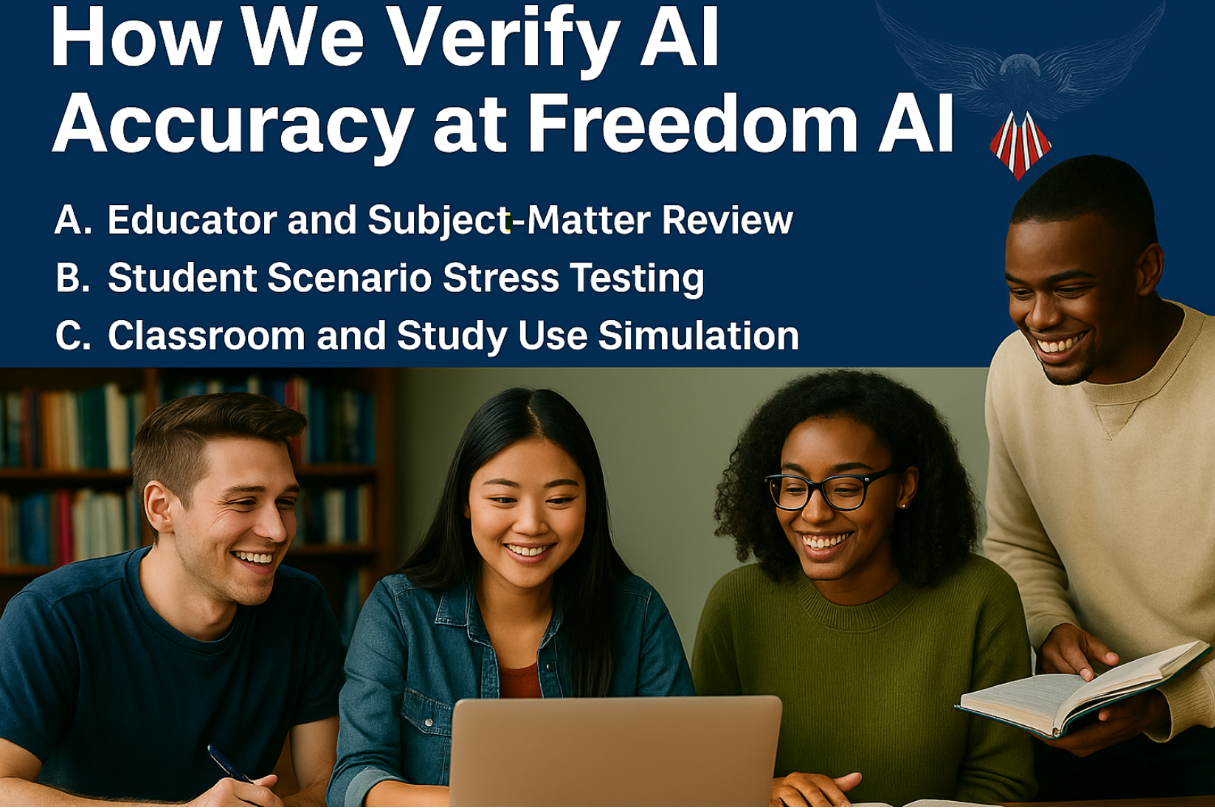
B. Educator and Subject-Matter Review
Teachers, professors, and academic reviewers assess:
Accuracy of content
Age-appropriate explanations
Bias and ethical alignment
Depth of reasoning
Clarity for learners at different levels
This step ensures the AI communicates as a great teacher would, not just as a machine.
C. Student Scenario Stress Testing
We test the system with realistic student behaviors such as:
Last-minute homework questions
Multi-step math breakdowns
Requests for simplified explanations
Misleading or ambiguous prompts
Attempts to get the AI to provide prohibited shortcuts
This helps the AI support learning without enabling cheating or harmful shortcuts.
D. Classroom and Study Use Simulation
We simulate real-life use cases such as:
Personalized tutoring
Study assistance
Concept reinforcement
Language learning
Research-building support
This ensures accuracy holds up where it matters most, in day-to-day learning.
3. Continuous Verification to Support Academic Integrity
In education, misinformation does not just lead to a wrong answer. It affects long-term learning.
That is why we use:
Automated knowledge-check systems
Drift monitoring to detect accuracy changes
Ongoing educator review cycles
Student feedback loops
Periodic curriculum realignments
Accuracy is an ongoing responsibility, not a one-time test.
4. Accuracy Results: What Students Can Expect
Our evaluations consistently show:
High Accuracy (85 to 95 percent)
Step-by-step math solutions
Scientific concept explanations
Grammar and writing feedback
Coding assistance
Summaries of provided content
Even tutors for each subjects
Moderate Accuracy (70 to 85 percent)
Open-ended essays
Complex analysis
Multi-part reasoning tasks
Subjective or interpretive questions
Lower Predictability
Brand-new predictions or hypothetical outcomes
Ambiguous historical interpretations
Tasks requiring human emotion, personal experience, or moral judgment
These results highlight an essential truth:
AI is a powerful learning partner, but students should still think critically.
5. Why Accuracy Matters for Students
In education, accuracy is not just a feature. It is the foundation of:
Strong learning outcomes
Academic honesty
Skill-building rather than shortcut-seeking
Confidence in independent thinking
Equitable access to high-quality explanations
Accurate AI helps students understand the why, not just copy the answer.
It helps educators build trust.
It helps institutions maintain academic integrity.
And most importantly, it helps learners grow.
Conclusion: Building a Future Where Students Learn With AI, Not From It
At Freedom AI, accuracy is part of our commitment to empowering human learning. Through rigorous testing, educator collaboration, and transparent evaluation processes, we ensure that our AI systems support genuine understanding, not shortcuts or misinformation.
AI will never replace teachers, but it can amplify their impact. It will never replace student effort, but it can guide it more effectively. With accurate, trustworthy tools, we can build an educational future that is more accessible, more personalized, and more empowering for every learner.